Faktor Faktor yang Mempengaruhi Produksi Tanaman Tomat (Solanum Lycopersicum)
(Di Kelurahan Kota Besi Hulu Kecamatan Kota Besi Kabupaten Kotawaringin Timur)
DOI:
https://doi.org/10.62951/flora.v3i1.563Keywords:
Fertilizer, Land Area, Pesticides, Seeds, TomatoesAbstract
This research was conducted in April 2024 in Kota Besi Hulu Village, Kota Besi Subdistrict, Kotawaringin Timur Regency. The research location was determined purposively. The objectives of this study were: (1) to analyze the characteristics of tomato farmers in Kota Besi Hulu Village, Kota Besi Subdistrict, Kotawaringin Timur Regency; and (2) to analyze the factors influencing tomato production in the same area. The sampling technique employed was a census (saturated sampling), in which all active tomato farmers who were members of farmer groups in Kota Besi Hulu Village were included as respondents. A total of 64 tomato farmers participated in this study. The data collected were analyzed using the Cobb–Douglas production function model. The results of the study in Kota Besi Hulu Village, Kota Besi Subdistrict, Kotawaringin Timur Regency, indicate important patterns in local farming practices based on data regarding land area, fertilizer use, seed use, pesticide use, and tomato production. The majority of farmers cultivated land ranging from 7,060.12 to 7,614.72 hectares, reflecting a tendency to manage relatively large farm areas. In terms of fertilizer application, most farmers used between 130.05 and 139.53 kilograms, suggesting a preference for higher input levels to achieve optimal yields. Regarding seed use, the dominant range was between 156.04 and 175.36 kilograms, which may contribute to better production outcomes. Pesticide application also showed a dominant pattern within the range of 4,001.72 to 4,878.76 liters, indicating farmers’ primary strategy in controlling pests and diseases.
References
Ahmed, R., Hussain, M., & Shah, S. (2018). The impact of fertilizer management on tomato production: Evidence from Pakistan. Agricultural Research and Technology Journal, 10(2), 105–113.
Ali, M., & Ali, S. (2017). Role of land area and soil management on tomato production: Evidence from Punjab, Pakistan. Journal of Horticultural Research, 25(1), 75–83.
Anisa, N., Lamusa, A., & Malik, S. R. (2022). Faktor-faktor yang mempengaruhi produksi tomat di Desa Labuan. Jurnal Ketahanan Pangan, 21(2), 148–155.
Badan Pusat Statistik. (2022). Produksi tanaman sayuran 2019–2022. Badan Pusat Statistik.
Bari Iskandar, M. R. (2017). Faktor-faktor yang mempengaruhi risiko produksi tomat di Kecamatan Ciawi, Kabupaten Bogor. Jurnal Agriekonomi, 22(3), 251–264.
Davis, J., Thompson, R., & Johnson, A. (2018). Effect of pesticide application on tomato yield: A comprehensive review. Journal of Pest Management, 34(3), 210–220.
Febrianti Rosalina, F., & Maipauw, N. J. (2021). Pengaruh usia produktif petani terhadap adopsi teknologi pertanian di Desa X. Jurnal Agribisnis Indonesia, 15(2), 123–135.
Garg, B., & Gupta, R. K. (2015). Impact of land use patterns on the productivity of tomato in Haryana, India. International Journal of Science and Research, 4(6), 1446–1452.
Gonzalez, M., Ramirez, L., & Martinez, P. (2020). The impact of pesticide use on tomato production in diverse agricultural settings. Agricultural Science Journal, 19(2), 145–156.
Iskandar, M. R. B. (2017). Faktor-faktor yang mempengaruhi risiko produksi tomat di Kecamatan Ciawi, Kabupaten Bogor. Jurnal Agriekonomi, 22(3), 251–264.
Johnson, M., White, L., & Green, P. (2021). Variability in tomato yield related to seed variety and management practices. International Journal of Vegetable Science, 27(1), 89–99.
Kiki. (2019). Pengaruh karakteristik petani terhadap adopsi teknologi pertanian di Desa X (Skripsi tidak diterbitkan). Universitas Padjadjaran, Bandung.
Kumar, P., & Kumar, A. (2018). Effect of land area and agronomic practices on tomato production in India. Agricultural Science Research Journal, 8(2), 55–62.
Kurniawan, I. (2019). Analisis faktor-faktor yang mempengaruhi produksi tomat (Lycopersicum esculentum Mill) di Desa Rasau Jaya I, Kecamatan Rasau Jaya, Kabupaten Kubu Raya. Jurnal Ketahanan Pangan, 18(2), 148–155.
Lalo, A., Syaiful, S., & Syukur, M. (2020). Faktor-faktor yang mempengaruhi produksi jagung (Zea mays L.) di Kecamatan Lahewa, Kabupaten Muna. Jurnal Agriekonomi, 25(2), 117–126.
Lee, S., & Kim, H. (2019). The role of seed treatment on tomato yield: Evidence from controlled experiments. Agricultural Research Journal, 22(4), 450–458.
Manyamsari, A., & Mujiburrahmad, M. (2014). Faktor-faktor yang mempengaruhi produktivitas padi di Jawa Tengah. Dalam P. W. Satriawan et al. (Ed.), Prosiding Seminar Nasional Pertanian (hlm. 123–135). Universitas Gadjah Mada Press.
Mubyarto. (1994). Ekonomi pertanian. Gadjah Mada University Press.
Nasir, M., Khan, M., & Ali, H. (2020). Fertilizer use efficiency and its effects on tomato yield: A case study from Bangladesh. International Journal of Plant Sciences, 12(4), 235–242.
Patel, S., Sharma, V., & Gupta, R. (2021). Pesticide effectiveness and its influence on tomato yield: Insights from recent studies. International Journal of Agricultural Research, 12(1), 77–89.
Rakhmat, J. (2022). Psikologi komunikasi. PT Remaja Rosdakarya.
Rukka, A., Jaya, M., & Sari, I. (2006). Pengaruh pengalaman bertani terhadap respons terhadap inovasi dalam usaha tani. Jurnal Teknologi Pertanian, 11(2), 112–126.
Sharma, A., & Singh, P. (2016). Effect of fertilizer application on tomato yield in Indian agriculture. Journal of Agricultural Science and Technology, 16(3), 678–688.
Smith, J., Brown, L., & Johnson, M. (2018). The impact of seed quality on tomato crop productivity. Journal of Agricultural Science, 25(3), 45–58.
Soekartawi. (2005). Analisis usaha tani. PT RajaGrafindo Persada.
Solihin, A. D., Sriyadi, & Buddhi, A. (2017). Faktor-faktor yang mempengaruhi produksi tomat di Desa Cibodas, Kecamatan Lembang, Kabupaten Bandung Barat. Jurnal Agriekonomi, 22(3), 265–278.
Sugiyono. (2016). Metode penelitian kuantitatif, kualitatif, dan kombinasi. Alfabeta.
U.S. Environmental Protection Agency. (2019). Solid pesticide formulations: Benefits and applications in agricultural settings. https://www.epa.gov/pesticide-science-and-assessing-pesticide-risks/solid-pesticide-formulations-benefits-and
Veren, H., & Hictorida, A. (2023). Usahatani tomat: Penggunaan faktor produksi dan analisis pendapatan petani. Jurnal Pertanian Modern, 10(2), 45–58.
Wang, X., & Li, Y. (2020). Land use efficiency and its impact on agricultural productivity: A case study of tomato production in China. Journal of Agricultural Economics, 71(4), 820–836.
World Health Organization. (2020). Guidelines on the use of liquid pesticides in agriculture. https://www.who.int/publications-detail/guidelines-on-the-use-of-liquid-pesticides-in-agriculture
Yanuarti, M., Prabowo, H., & Suherman, E. (2022). Pengaruh pendidikan terhadap penyerapan teknologi dan informasi serta manajemen produksi di sektor pertanian. Jurnal Pertanian dan Teknologi, 15(3), 45–59.
Zulfadli. (2023). Metode penelitian pendidikan. Pustaka Cendekia.
Downloads
Published
How to Cite
Issue
Section
License
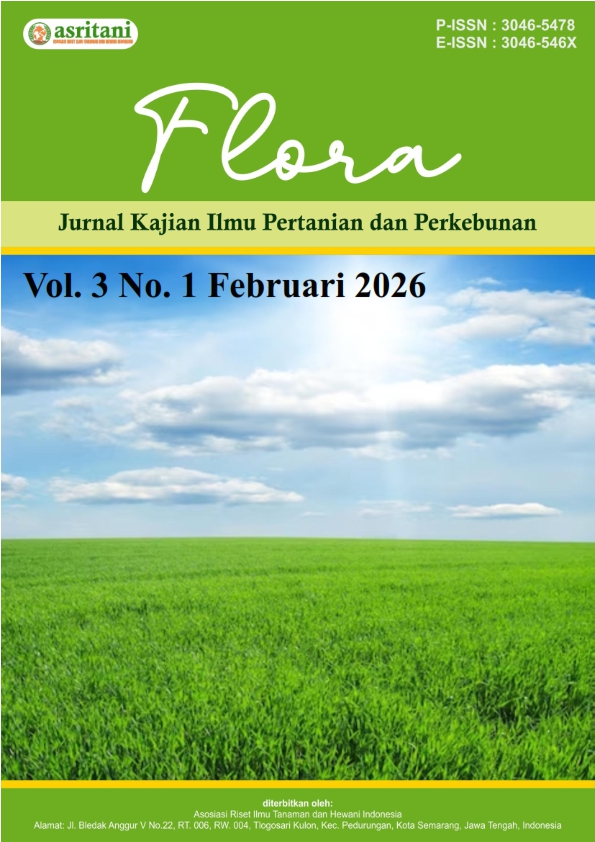
Copyright (c) 2026 Flora : Jurnal Kajian Ilmu Pertanian dan Perkebunan

This work is licensed under a Creative Commons Attribution-ShareAlike 4.0 International License.